

There’s a group of pixel artists who have made it big in the real world. Three men in Berlin and one in New York call themselves eBoy, and they make pixel art that has appeared in magazines, on albums, posters, Web pages, commercials, and in other places besides. Formed in 1998, eBoy’s mission is simply to give the four artists a “stage and a shared identity and a shelter from all the killers out there.”

eBoy’s work resembles, but does not spring directly from, video games. Only the New York quarter of the team draws from a childhood of gaming; the other three grew up in East Germany where video games weren’t quite as well known. Instead they draw from other pop-culture elements, such as television, advertising, supermarkets, and Lego. Their art runs the gamut from simple faces, animals, and rampaging beasts, to giant cityscapes filled with isometric buildings, vehicles both worldly and fantastic, designer trees, and the occasional nipple. Their art often brings immediately to mind an era of games gone by. There’s a familiarity, almost like déjà-vu, about their pictures. It’s the pixels and the geometric precision that cause the recall. Games like Sim City look almost but not exactly like the cities created by eBoy. All of us have seen icons that look, at first glance, like some of the rogues in eBoy’s bizarre galleries. It’s an illusion, however. There never was an era in games that mixed the primitive graphic approach eBoy employs with the number of hues and shades they rely on. These creations spring from an age that video gaming skipped, an age of unlimited color and resolution without even a nod toward realistic use of perspective or proportion. And yet, for all the reasons that eBoy’s work couldn’t have come from games, they still look like they do—and that is part of .
eBoy’s works are playful, colorful, and wonderful. Part toy landscape, part video game, and part cultural statement, each image grabs your attention and holds it tight. There never was an era in games that mixed the primitive graphic approach eBoy employs with the number of hues and shades they rely on. These creations spring from an age that video gaming skipped, an age of unlimited color and resolution without even a nod toward realistic use of perspective or proportion. And yet, for all the reasons that eBoy’s work couldn’t have come from games, they still look like they do—and that is part of their unique appeal.

There’s a growing demand for the kind of art eBoy creates. Their client list includes an impressive array of global companies. Amazon, Coca-Cola, Renault, Adidas, and MTV are but four from an impressive roster. It has been remarked that eBoy might have been right at home in the 16-bit era of gaming. Their work evokes the very best qualities of the old school. They’re simple, they’re complex, they’re colorful, and they’re large. There’s no doubt they might have been comfortable designing game graphics back then, but it doesn’t really seem they’re having out of their element now.It’s an interesting phenomenon that pixel art, created at first solely for video gaming, has moved on, beyond the games, and is now found in great numbers on home pages, magazines, and grafitti. Even unanimated, these chunky stacks of blocks are breathing with a life of their own. You can find them everywhere, drawn by anyone, and with newer techniques and better tools, they’re looking better than ever before.





 In 1969, as a tribute to Rockwell's 75th year birthday, officials of
Brown & Bigelow and the Boy Scouts of America asked Rockwell to pose
in Beyond the Easel, the calendar illustration that year Rockwell's work was dismissed by serious art critics in his lifetime Many of his works appear overly sweet in modern critics' eyes, especially the Saturday Evening Post
covers, which tend toward idealistic or sentimentalized portrayals of
American life— this has led to the often-deprecatory adjective
"Rockwellesque." Consequently, Rockwell is not considered a "serious
painter" by some contemporary artists, who often regard his work as bourgeois and kitsch. Writer Vladimir Nabokov sneered that Rockwell's brilliant technique was put to "banal" use, and wrote in his book Pnin: "That Dalí
is really Norman Rockwell's twin brother kidnapped by Gypsies in
babyhood". He is called an "illustrator" instead of an artist by some
critics, a designation he did not mind, as it was what he called
himself.(sumber : wikipedia)
In 1969, as a tribute to Rockwell's 75th year birthday, officials of
Brown & Bigelow and the Boy Scouts of America asked Rockwell to pose
in Beyond the Easel, the calendar illustration that year Rockwell's work was dismissed by serious art critics in his lifetime Many of his works appear overly sweet in modern critics' eyes, especially the Saturday Evening Post
covers, which tend toward idealistic or sentimentalized portrayals of
American life— this has led to the often-deprecatory adjective
"Rockwellesque." Consequently, Rockwell is not considered a "serious
painter" by some contemporary artists, who often regard his work as bourgeois and kitsch. Writer Vladimir Nabokov sneered that Rockwell's brilliant technique was put to "banal" use, and wrote in his book Pnin: "That Dalí
is really Norman Rockwell's twin brother kidnapped by Gypsies in
babyhood". He is called an "illustrator" instead of an artist by some
critics, a designation he did not mind, as it was what he called
himself.(sumber : wikipedia)
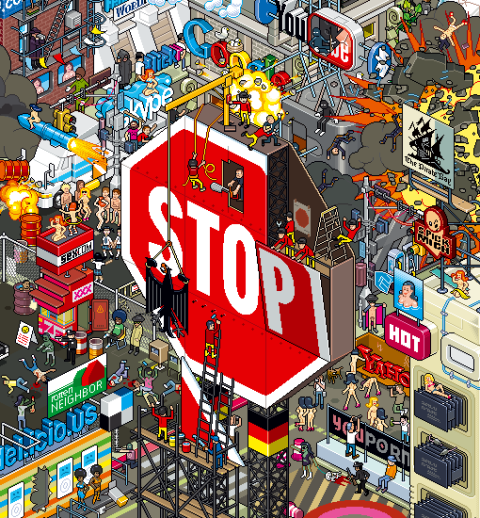
 There’s a group of pixel artists who have made it big in the real world. Three men in Berlin and one in New York call themselves eBoy, and they make pixel art that has appeared in magazines, on albums, posters, Web pages, commercials, and in other places besides. Formed in 1998, eBoy’s mission is simply to give the four artists a “stage and a shared identity and a shelter from all the killers out there.”
  eBoy’s work resembles, but does not spring directly from, video games. Only the New York quarter of the team draws from a childhood of gaming; the other three grew up in East Germany where video games weren’t quite as well known. Instead they draw from other pop-culture elements, such as television, advertising, supermarkets, and Lego. Their art runs the gamut from simple faces, animals, and rampaging beasts, to giant cityscapes filled with isometric buildings, vehicles both worldly and fantastic, designer trees, and the occasional nipple. Their art often brings immediately to mind an era of games gone by. There’s a familiarity, almost like déjà-vu, about their pictures. It’s the pixels and the geometric precision that cause the recall. Games like Sim City look almost but not exactly like the cities created by eBoy. All of us have seen icons that look, at first glance, like some of the rogues in eBoy’s bizarre galleries. It’s an illusion, however. There never was an era in games that mixed the primitive graphic approach eBoy employs with the number of hues and shades they rely on. These creations spring from an age that video gaming skipped, an age of unlimited color and resolution without even a nod toward realistic use of perspective or proportion. And yet, for all the reasons that eBoy’s work couldn’t have come from games, they still look like they do—and that is part of . eBoy’s works are playful, colorful, and wonderful. Part toy landscape, part video game, and part cultural statement, each image grabs your attention and holds it tight. There never was an era in games that mixed the primitive graphic approach eBoy employs with the number of hues and shades they rely on. These creations spring from an age that video gaming skipped, an age of unlimited color and resolution without even a nod toward realistic use of perspective or proportion. And yet, for all the reasons that eBoy’s work couldn’t have come from games, they still look like they do—and that is part of their unique appeal.
 There’s a growing demand for the kind of art eBoy creates. Their client list includes an impressive array of global companies. Amazon, Coca-Cola, Renault, Adidas, and MTV are but four from an impressive roster. It has been remarked that eBoy might have been right at home in the 16-bit era of gaming. Their work evokes the very best qualities of the old school. They’re simple, they’re complex, they’re colorful, and they’re large. There’s no doubt they might have been comfortable designing game graphics back then, but it doesn’t really seem they’re having out of their element now.It’s an interesting phenomenon that pixel art, created at first solely for video gaming, has moved on, beyond the games, and is now found in great numbers on home pages, magazines, and grafitti. Even unanimated, these chunky stacks of blocks are breathing with a life of their own. You can find them everywhere, drawn by anyone, and with newer techniques and better tools, they’re looking better than ever before.